DOI: https://doi.org/10.37162/2618-9631-2021-1-15-19
УДК
551.5
Европейская сеть
регионального климатического
центра ВМО и результаты Форума
региональных климатических центров 2020
Стефан Роснер
Координатор климатического центра
распределенной сети в Европе
(RCC RAVI-Network), Немецкая
служба погоды, Оффенбах, Германия
Европейская
сеть регионального климатического центра ВМО (РКЦ) организована как сеть с разносторонними
функциями. Задача кооперации и общения между институтами-участниками сети имеет
высокую важность. Было принято решение проводить семинары/форумы пользователей
сети РКЦ и координационные совещания РКЦ каждые четыре года. Последний Форум
пользователей РКЦ и Координационное совещание прошли 20–22 и 29 октября 2020 г.,
соответственно, в виртуальном формате, в связи с пандемией COVID-19.
Это первое онлайн мероприятие, в котором приняло участие 81 представитель
национальных метеорологических и гидрологических служб (НМГС) и ВМО, в
ходе которого были сформулированы 36 направлений деятельности, которые
должны быть реализованы для улучшения деятельности сети РКЦ и обслуживания ее
конечных пользователей, НМГС в регионе.
Ключевые слова: сеть регионального климатического центра,
RA VI, форум пользователей, климатическое обслуживание, производительность
работы сети
The WMO RA VI RCC Network and Results
from the RCC Users Forum 2020
Stefan Rösner
Coordinator
WMO RA VI RCC Network, Deutscher Wetterdienst,
Offenbach, Germany
The WMO RA VI Regional
Climate Centre (RCC) is organized as a Network with dislocated functions. This
is a challenge for communication among the contributing institutions. It
therefore had been agreed to hold RCC Network Workshops/ Users Forums and RCC
Coordination Meetings at least every four years. The latest RCC Users Forum and
the Coordination Meeting have been held on 20-22 and 29 October 2020, respectively, both as virtual meetings, due to
the COVID-19 pandemic. This first time virtual event allowed for participation
by up to 81 representatives from NMHSs and WMO, and identifies 36 activities to
be implemented in order to improve RCC Network performance and services to its
end users, the NMHSs in the Region.
Keywords:
Regional Climate Centre Network, RAVI, User Forum, climate services, network
performance
1. The WMO RA VI RCC Network
The World Meteorological Organization (WMO)
is working towards establishing Regional Climate Centres (RCCs) in all six
Regional Associations (RAs). In addition, several cross-regional RCCs and an
Antarctic RCC are being discussed. Each RCC is a centre of excellence that
assists WMO Members in a given region to deliver better climate services and
products including regional long-range forecasts, and to strengthen their
capacity to meet national climate information needs. RCCs are WMO-mandated activities
and comprise an important regional component of the Global Framework for
Climate Services (GFCS) Climate Service Information System (CSIS).
For Regional Association VI, Europe there is
only one RCC, which is implemented as a network. However, there is some
geographical overlap with the ArticRCC in the North, also organized as a
network.
The WMO RA VI RCC Network has been designated
in 2013 by the WMO Executive Council in its sixty-fifth session (EC-65), while
preparation started as early as 2008. Since its beginning, the network had ten
members that contribute by regional and or sub-regional products to one or more
nodes. The nodes are organized along functions, i.e. data services, climate
monitoring and long-range forecasting. Each of the node is led by one member,
e.g. the Node on Climate Data Services is led by The Netherlands (KNMI), the
Node on Climate Monitoring is led by Germany (DWD), and the Node on Long-range
Forecasting (LRF) is jointly led by France (MF) and the Russian Federation
(NEACC).
Fig 1 maps the members of the WMO RA VI RCC
Network – the consortium – highlighted in light green. The red triangles
indicate consortium members that contribute to the Node on Data Services (DS),
i.e. France, Hungary, Norway, Serbia, Sweden, and Turkey. The yellow circles
show consortium members contributing to the Node on Climate Monitoring (CM),
and the solid green squares those contributing to the Node on Long-range
Forecasting (LRF). The monitoring node is supported by Armenia, France, The
Netherlands, Serbia, and Turkey. The LRF node is supported by Norway, Serbia,
and Turkey.
2. Results from the RCC Users
Forum 2020
For the RCC Network it is important, though
also complicated to ensure good communication among its nodes and consortium
members. This is easier for RCCs that have all functions concentrated at one
location, in one organization.
Therefore the RCC Network regularly, although
not too often holds RCC Workshops, and coordination meetings. While RCC
Workshops bring together all WMO Members in the Region, coordination meetings
are for consortium members to discuss issues related to operation and advancing
the functions and services offered by the network.
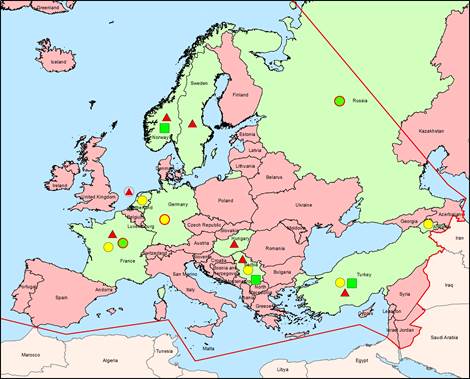
Fig. 1. Mapping WMO RA VI
RCC Network. Red triangles, yellow circles and green squares indicate
consortium members of the nodes on climate data services, climate monitoring,
and long-range forecasting, respectively. The respective lead is indicated by a
red circle.
RCC Workshops have been held in 2010, 2011,
2016 and 2020. Coordination meetings in 2010, 2013, 2016, and 2020.
The latest RCC Workshop was held from 20 to
22 October 2020 as a virtual meeting due to the Covid-19 pandemic, and was also
renamed RCC Users Forum, which it essentially always has been. The online forum
was held as a virtual meeting for three hours each day. The overall experience
with this new approach was very positive as it also allowed for additional
experts to participate. The forum was attended by up to 81 participants!
Based on experiences from past RCC Workshops
it was decided to use a survey ahead of the forum to collect important input
from the WMO Members in the Region including on general aspects of the RCC
performance and new and additional requirements. In addition the survey allows
to monitor the performance of the RCC Network by repeating the same questions
with the next survey. The survey was completed 31 times from 20 WMO Members.
The overall satisfaction with the performance of the RCC Network was quite
good. On a scale from 1 to 10 (low to high) 87% ranked the relevance of the WMO
RA VI RCC Network for their respective institutions 5 and higher (fig. 2).
Looking at the individual Nodes, they have been ranked 5 and higher by 84%,
87%, and 71% for the Data Services, Climate Monitoring, and Long-range
Forecasting Nodes, respectively.
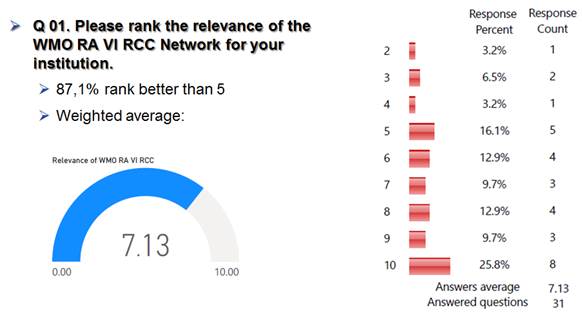
Fig. 2. Relevance of the WMO RA VI RCC Network for the institutions.
During the Users Forum 36 activities have
been identified that would contribute to advance the services provided by the
RCC Network.
To highlight a few of the activities:
·
better communication: this is a special challenge for networks with
dislocated functions compared to RCCs with all functions in one location/
institution. This would include a process to engaging members of the consortium
in the definition of Climate Watch Advisories (CWAs). This would also include
setting up a collaboration platform for developing joint papers;
·
relationship with Copernicus: Copernicus is a service funded by the
European Commission that includes provision of products relevant to, similar
and in parts overlapping with those from the RCC. However, while Copernicus is
aiming at serving the general public, RCCs are supporting the NMHSs in the
Region to better serve their users, including the general public. Thus, there
is an increasing opportunity to make services provided by Copernicus available
to all NMHSs in the Region. In addition, Copernicus can contribute to a WMO
State of the Climate in the Region report;
·
another activity relates to improving the availability of data. Exchange
of all observations taken in the Region will improve the quality of products
from the RCC Network. Furthermore, the Mediterranean Climate Outlook
Forum (MedCOF) is also
interested to enhance data availability from Northern Africa.
3. Results from the RCC
Network Coordination Meeting 2020
The coordination meeting was held as a
virtual meeting on 29 October, one week after the forum in order to allow
participants to digest to forums’ outcomes. Participants in the coordination
meeting have been the node leads and representatives of the RCC Network
Consortium.
The main purpose of the coordination meeting
was to work through the actions identified in the forum and assign priorities,
deadlines, and identify responsibilities.
In addition, issues related to training
functions of the RCC Network have been addressed and participants heard a
presentation by the Regional Training Centre IBE[1]
in Italy. Participants also discussed issues related to the upcoming WMO RA
VI-18 session.
Participants were also informed about the
potential role of RCCs in raising the visibility of NMHSs at the political
level, e.g. in the Regional UN System, the Regional UNECE Forum on Sustainable
Development or via the UN Country Teams and UN Resident Coordinators by
participation in the Regional UN System Coalition on Environment and Climate
Change. The WMO RA VI Regional Office is participating in these activities,
promoting the use of services provided by the RCC and NMHSs.
Поступила
19.01.2021; одобрена после рецензирования 02.03.2021;
принята в печать 23.03.2021.
Submitted 19.01.2021; approved after
reviewing 02.03.2021;
accepted for publication 23.03.2021.
.